Showing posts with label Ranulphus de Kingsley. Show all posts

Tuesday, August 27, 2013

An Expert's Conclusions on the Ranulphus de Kingsleigh Story

I consulted a medieval expert on the Ranulphus de Kingsleigh story.  He looked at the story in depth and responded with the following summation.  I will not publish the entire letter, just the points that are most integral to clarifying this story.

"I am the Medieval expert.  I took a look at your question and story and compared it with historical facts.

"The two kings in the story are Rufus and Henry, brothers.  Rufus was cruel, selfish, and unjust.  His brother Henry was a just man.  When he ascended to the throne after Rufus' death, he issued many judicial and lawful reforms.  His title or nickname was the 'lion of Justice.'"

"I came up with four different conclusions:

"1.  Rufus could have had a brief change of heart.  He could have been touched that this commoner (Ranulph) was kind to him despite the fact that Rufus was mean to everyone.  I think of this as unlikely since Rufus doesn't seem to be a thankful person.

"2.  Rufus could have given Ranulph the land and title so Ranulph would be on his side.  During Rufus' reign, he had many rebellions to deal with as a result of him being such a nasty ruler.  Since a king needs allies, Rufus used this as an opportunity to get Kingsley on his side.

"3.  The king could have been Henry.  Since Henry was a much nicer ruler than his brother, he would have been more inclined to return the kindness.

"4.  It could have been Henry when he was not yet king and Rufus was the king.  When Henry came to the throne, he rewarded Kingsley for his kindness.  And since Henry was the king at the time, he could be referenced as the king in the story (even though he wasn't yet king when the story took place.)

"Personally I think that Henry was the king in the story since it fits Henry's personality a bit more.  Henry was dedicated to the system of laws and enforcing those laws.  As a result, he would try to break up the land of some nobles to prevent them from causing problems.  During the Middle Ages, if nobles had enough land, they could act as independent kings in their own little areas.  That was the reason why the French kings were so weak during the middle ages. 

"These are the conclusion that I came up with.  I am not saying that one of them is correct.  However these are most likely.  I am just giving you the facts and my conclusions.  Elder Frost (of the LDS Family History Library Staff)"

Photo of the LDS Family History Library courtesy of family search.com

Wednesday, September 26, 2012

Ranulph de Kingsley Legend Digested by William Arthur Kingsley

In his book "Kingsley Family of America,"  author William Kingsley digests the legend using many sources.  Some of them are the same that I have been researching to confirm the story.  Some are unpublished sources.  They are:

Deane, Edna Amos Kingsley
Brown, Dr. LeRoy Joseph Kingsley and his Descendants (not published)
Kingsley, Dumont  Kingsley Genealogy (not published)
Anjou, G.  Kingsley Family (not published)
Burke, Armorial Bearings Genealogy Lineages
Ormerod  History of Cheshire
Montague Genealogy
Charters, Plea Rolls, Recognition Rolls, Inquisitions

"The following account is in part the matter of record while some parts remain unproved, therefore; it must be considered as; "Kingsley Lore."  The origin of the family and the surname Kingsley started when William the Conqueror, the Norman King of England was succeeded by his third son William the second also known as 'Rufus the Red King' ruled England between 1087 -1100.  Early in his reign he suffered a revolt of his Barons.

"Tradition says he went hunting in New Forest or Vale Royal one day and became separeated from his companions and attendants.  He became lost and wandered aimlessly throughout the forest and glades, towards the eve of night seeing a light beaming from a forest's cabin.  He approached the cabin and without making himself known to the forester.  The forester offered him a night's shelter. 

"The forester by name of Ranulphus slaughtered a young goat and his wife prepared a savory repas.  The King was refreshed by the evening meal and was offered a humble co0uch in which he slept that night and in the morning partook of another bounteous repas. (p.7)

"In the bright of day he discovered he was in his own lea.  He was so delighted with the forester's hospitality that he bestowed the whole of that portion of his domain known as the King's Lea upon his host Ranulphus the Forester, and made him a Baron.  Ranulphus took the name of the land King's lea, "Kingesleigh" Kingsley.  He became known as Sir Ranulphus de Kyngesliegh. Later the family crest contrained a Baron's Crown surmounted by a goat's head.

"Before 1128 Ranulphus de Kingsley, known as the first, was made grantee of the forest of Mara and Modrem by the third Earl of Chester, Sir Randall Meschines.  A hereditary right later known as "Hereditary Master Forester of Delamere" and was given a bugle horn to wear at his side.  A symbol of the hereditary Master Forestership of Delamere."  (p. 8)

Author William Kingsley labels this 'lore' but meshes records with the legend.  Perhaps it is legit...

Tuesday, September 18, 2012

Ranulph-- Facts versus Legend

Prior to the invasion of the Normans in 1066, the area called Kingsley was populated by peasants who worked the land under the protection of Lord Dunning inhabiting the manor at Kingsley.  This was the typical Middle Age 'Feudalism.'  Under King Robert of England, nobles had power over sections of the kingdom.  Lords ruled over estates, or manors.  Peasants lived on the estate, providing food, services and supplies to the Lord in the manor.  Lords and nobles helped the King keep the kingdom safe and intact.  (Armstrong)

When Duke William of Normandy invaded, the Welsh nobles and lords were unable to defend themselves.  The whole of England fell to William 'the Conquerer.'  He replaced the Lords with his military heroes now holding the title of 'Earl' instead of 'Lord.'  With new Earls in the manors, the Feudalistic society resumed, although the peasants were unhappy with the new Norman leaders.  For one, their ability to hunt for food was gone.  The forest was now off limits to all but the nobles.  Kingsley was 'afforested' at this point, or trees were planted in the effort to make it a forest in order to provide a pleasant hunting ground for the nobility.  Hunting was one of King William's great passions. (Armstrong, Ormerod)

Within a few years, King William ordered a census of the land.  That census, called the 'Domesday' gives a great description of each area, complete with an accounting of value and inhabitants for the year 1086, and a history of the Lords displaced in 1066.  According to Domesday, Kingsley was very sparsely inhabited.  Remarkably, King William allowed Dunning to remain on the estate as Lord, but gave his friend Earl Hugh of Chester (Huge d'Avranches "Lupus" ie: the wolf)  ownership.  He became the tenant in chief.  In other words, Dunning was allowed to stay but he was there only at the pleasure of Earl Hugh D'Avranches.  (Ormerod)

D'Avranches was the Earl of Chester, the first in a long line of Earls that resided in Chester nearby.  He replaced Gherbod the Fleming, who served for a short time before returning to Flanders.  (Deane)  This earldom was the most prestigious because it became known as the one that the heirs in line to the throne inherited.  In the Domesday census, Chester is valued in one section as worth 50 gelds and King William is the Lord and Tenant in Chief.  The other sections of Chester were given to the various churches on the property.  One such section shows that Earl Hugh of Chester replaced King Edward as the Lord.  This shows the strategic and political import of Chester.  (Ormerod)

Over time, Hugh Earl of Chester passed away, leaving the title and his lands to his son Richard D'Avranches.  In 1120, Richard, Second Earl of Chester died in the White Ship Disaster.  This disaster claimed the life of King Henry I's son William as well.  These deaths emboldened the Welsh in Cheshire; they raided Cheshire, burning, looting and killing, eventually setting two castles afire.  King Henry I promptly installed his father's friend's nephew Randle/Randal/
Ranulph/Ralph le Meschin as the Third Earl of Chester.  Randle's father Ranulph de Briquessart, had been a close advisor to William the Conquerer, Henry I's father.  Randle had also helped Henry I in several battles, notably as the first line of force as they marched into battle.  Randle led the first line, King Henry I rode in the second.  Henry trusted Randle to settle the villagers down.  Thus King Henry recognized Randle as Richard's successor in the county of Chester. (Wikipedia:  Earl of Chester)

Randle was expected to distribute some land to his followers, now that he was an 'incoming regional magnate.'  In 1112 he distributed some to the church, founding a monastery.  He created two Baronies in the area and tried to create a third.  And in 1123 he gave Kingsley to our ancestor Ranulph de Kingsley.  Randle must have done this prior to his departure by order of Henry to strengthen the garrison at Normandy that year.  Additionally, Randle gave Ranulph the 'Master Forestership' of the forests of Mara and Mondrem, the remnants of which are now called the Forest of Delamere.  (Wikipedia:  Ranulf le Meschin, 3rd Earl of Chester)

The forests of Mara and Mondrom were hard to separate, they existed so closely together.  They probably contained some of the trees that had been planted 60 years earlier following the Norman invasion.  These forests were set aside by William the Conqueror to be used exclusively by the royals and were jealously guarded.  Anyone caught poaching was liable to be whipped, and could even be killed.  (Harrison)  This might be the basis for the spite-filled "Old Brown Forest" ballad decrying the insanity of killing men if they hunt therein for food, making shelter for animals while the poor peasants were unhoused.  A powerless people records their travails in song to pass down the history to their descendants. 

Ranulph de Kingsley was the first to assume responsibility of 'Master Forester' over these forests.  He was given a distinctive horn, which provided a symbol of his authority. 
This was originally considered a burden, not an honor, but over time privilege due to the authority and status.  That authority allowed Ranulph to inflict judgement on poachers, as well as hunt freely for smaller animals like foxes, hares, squirrels hawks and eagles.  And they were allowed to keep any downed trees or dead beasts found withing the forest.  They also could 'tithe' the inhabitants of the forest of their goods.  Additionally, when the Royals came to hunt, the Master Forester was required to join the hunting party with two 'white greyhounds whenever the Earl was disposed to honour the forest of Delamere with his presence in the chase.'  Being the first Master Forester, these duties, perks and privileges were invented at the time of his appointment.  (Harrison, Ormerod)


How dies this relate to the Goat Legend?  If King Rufus had been the king who became lost in the forest, Ranulph would have been under 20 years old, although he could have perhaps been married.  Perhaps Rufus had become separated from his party and become lost in the forest, finding shelter in a cabin with a local forester and his wife.  Perhaps they shepherded goats, and seeing his status by his regalia, although not realizing he was the King, they treated him with respect and honor.  Perhaps other inhabitants may have treated him roughly, seeing that he had taken their right to hunt from them.  Perhaps Rufus understood the hard feelings the peasants had for him, providing even more contrast to Ranulph's treatment of him.  

 
Perhaps as a forester living therein, Ranulph not only fed the king but also led him out of the forest, thereby earning the respect of the king as to his understanding and knowledge of the forest environs.  That would be a great reason to make Ranulph the first Master Forester.  Perhaps he was extremely qualified and poaching had become a nuisance to manage.  This assignment gave the job to someone who knew the forest well and could punish those peasant poachers better.


But we still haven't considered the other problems-- that he had already given the land to the Earl of Chester or that the land was given perhaps some twenty years after Rufus had died.

All records agree that it was Randle, the Earl of Chester who gave Ranulph the land and the title, not the king.  He gave much land away between 1120 and 1123 for a variety of reasons.  (Wikipedia:  Ranulf le Meschin, 3rd Earl of Chester)  This could be easily overcome by several explanations.  Perhaps the promise was given just prior to the king's death in 1100.  Perhaps the king assigned someone to make it happen and the process dragged on for some twenty odd years.  Perhaps the king spoke to his friend Hugh First Earl of Chester, who agreed to give the land to Ranulph, then the king died.  The promise was delayed, and not carried out until Randle Third Earl of Chester was expected to give up his lands as mentioned. 

Dates for each event contradict each other.  Ormerod simply says that the land was given to Ranulph 'after a very short period [after the conquest]' and he links the timing with the Master Forestership, later saying simply that they occurred in the 12th century.  Bevan assigns the date of Master Forester to 1123, but doesn't mention the land.  Deane gives the date of the land gift between 1087 and 1100; the Master Forestership 1123. 

Perhaps it was really Randle who became lost, being called King because he was Earl of Chester, the title that is generally given to those in line to the throne (so he was kind of a prince or future king.)  


I haven't even mentioned the part 'Baron' part of the legend.  No record exists that substantiates that Ranulph was made a baron, although it is possible.  Most records refer to him and his heirs with the title 'Sir.'  The coronet on the Coat of Arms is of a Duke, not a Baron.  Clearly an expert is needed to tease the significance of these tidbits to our mystery.

As one who would like to believe that kindness and a good stew were enough to qualify a land owning Saxon farmer for a gift of wealth and honor, I would like to make this legend fit the facts as stated above.  Clearly, Ranulph did SOMETHING to merit the good graces of Randle, Earl of Chester, to merit the gift of the land of Kingsley and the Master Forestership of Mara and Modrem.  Perhaps someday we will know if this legend does correlate with the facts more closely.  


Sources:
Armstrong, Monty; David Daniel; Abby Kanarek, Alexandra Freer.  Cracking the AP World History Exam New York.  2012:142-144, print.
Bevan, R. M. Tarporley & Beeston Country, United Kingdom.  2006:n. pag. web.
Brown, Leroy.  Kingsley Genealogy 1907: St. Paul, Minn.  Preface, print.
Domesday Book.  1086:n. pag. web.
Earl of Chester. Wikipedia. 27 Aug 2012:n. pag. web.
Egerton, Leigh.  Ballads and Legends of Cheshire.  London.  1866:36-40. Print.
Forests of Mara and Mondrem.  Wikipedia.  3 Aug 2012:n. pag. web.
Frank, Katherine.  A Voyager Out:  The Life of Mary Kingsley.  Taurus Publishers.  2005:6-7, print.
Harrison, William.  "Ancient Forests, Chases and Deer Parks in Cheshire."  Historic Society of Lancashire and Cheshire, Liverpool.  Proceedings and Papers.  20:1-28. Print.
Ormerod, George.  The History of the County Palatine and City of Chester.  London. 1819:3, 43, 50, 55. print.
Ranulf le Meschin, 3rd Earl of Chester
. Wikipedia. 22 June 2012:n. pag. web. 

Monday, September 17, 2012

Ranulph de Kingsley's bugle

This illustration of a bugle appears in Edna Hartshorne Deane's biography of Amos Kingsley published 1961 with the following inscription:

Bugle horn:  The horn dates from 12th century.  It is the symbol of the hereditary Master Forestership of Delemere.  It was given to Ranulph (Ralph) Kingsley by Sir Randall, Earl of Chester, in 1123 A.D. (Pg. 14)

Apparently a descendant of Ranulph named Maretta Hartshorn of Washington D.C. visited Ardene Hall in Tarpoley, where the horn was in possession of the Hamilton family in 1938.  She was able to see the actual bugle shown in this illustration.  "... A male servant was very courteous and showed her the bugle given by the Earl of Chester to Ranulph (Ralph) Kingsley more than eight-hundred years ago."  (pg. 18)

Kingsley Coat of Arms-- Which one?

I have seen so many Kingsley coats of arms, it's rather dizzying.  But one of them stands out.  I want to post them and source and my commentary...

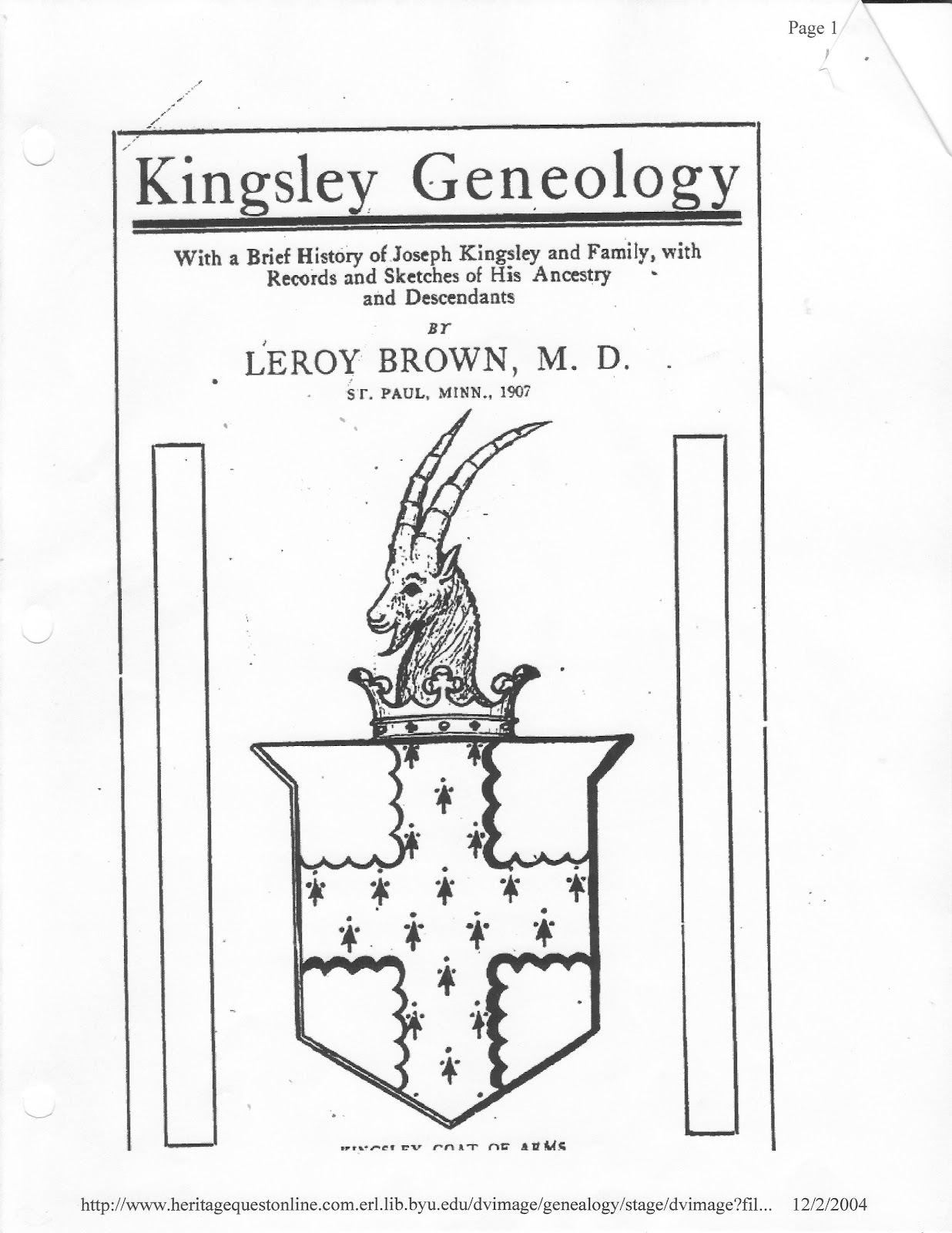
Below this coat of arms is written:  Kingsley coat of arms (frontispiece.)  The Kingsley coat of arms is a very early one, so has no motto.  It dates back to 1189 King Richard, Called the Lion, King of England, was one of three leaders in the Third Crusade to the Holy Land, in herald terms:  Vert, cross engrailed ermine.  Crest:  in a ducal coronet gules, a goat's head argent.  Describing it in simpler terms:  On a green shield is a white cross adorned with ermine.  Above the shield is a helmet with mantling or cloak that protected the wearer from cold or heat.  Above the helmet is a silver goat's head resting on a ducal coronet colored red.  This was often adorned with pearls and strawberry leaves.

This one is found in Edna Hartshorne Deane's book "Amos Kingsley 1768-1847" on page 9.  It seems to show some elements of the Goat Legend with the goat's head and the crown.

------------------

Here is another one, which I featured in the post which shares the Goat Legend.  This appears in the book by Dr. Leroy Brown dated 1907, as you see in the photo.  It seems to have the same elements in the crown and the goat, but is missing the knight.

---------------------

This one appears in George Ormerod's book "The History of the County Palatine and City of Chester" dated 1819 page 44.  This is what is written to describe the crest: "Arms:  Vert, a cross engrailed Ermine, On an escucheon of pretence Argent, a bugle horn, strung Sable."  It seems to focus on the Master Forestership, not the Goat Legend.

It must be noted that this is the same wording used to describe the coat of arms noted author, Charles Kingsley claimed.  This is what is written about it in the book "Charles Kingsley:  His Letters and Memories of His Life" Vol II, published in 1894.

"The bugle horn, alluded to in the old song, and which is in his coat of arms, was the one which his ancestors, as Foresters to Earl Randall, had the right to wear.  The grandson of this Ranulph, Ralph de Kingsley, married Mabilla de Moston in 1233, and the same coat of arms, 'vert a cross engrailed ermine on an escocheon of pretence Argent, a bugle strung sable,' have been carried by the family through many reverses to the present day."  (P. 241)

If this statement is true, then this coat of arms dates nearly back to the one claimed by Edna Deane of 1189 shown above.


Which one was truly used by our Ranulph de Kingsley?  Did they evolve over time?  Was the land given to Ranulph first, then later the Master Forestership, hence a change in arms?  Clearly the history books focus on the Master Forestership, not the land. 

Ranulph source: Domesday Census of Kingsley

The Domesday book is the census ordered by King William the Conquerer after he took over England in 1066.  The book was finished in 1096 and contains the details of the land William won.  It was written in Latin in shorthand, making it difficult to translate into English.  One can search for areas by place in a database at http://domesdaymap.co.uk/place/

Looking up 'Kingsley' provided some interesting details about the area.  First, and foremost Kingsley existed in 1086, decades before Ranulph was granted the land there. Here is the entry in it's database form:

Place:  Kingsley
Hundred:  Ruloe
County:  Cheshire
Total population:  9 households (quite small)
Total tax assessed:  1 geld unit (very small)

Value to lord in 1066:  1.5
Value to lord in 1086:  0.3
Households:  1 villager.  3 smallholders.  5 slaves.
Ploughland:  2 ploughlands (that is 60 acres each) 1 lord's plough team
Other resources:  woodland 1 x 1 league, 1.5 fishery
Lord in 1066:  Dunning (owned 34 properties)
Lord in 1086:  Dunning (now owned only 3 properties, noted for having kept this estate when most estates were taken by the Normans.  See Ormerod p. 3)
Tenant-in-chief in 1086:  Earl Hugh of Chester  (he is the first Earl of Chester, died in 1101.)

Note that this entry shows that the Earl of Chester had been granted this land, but that he allowed the former lord Dunning to remain on the land.   This land would stay with the Earl of Chester as that title passed from Hugh to his son Richard, then to Randle, who gave the land to Ranulph de Kingsley.  See 'Wikipedia:  Earl of Chester'


Ranulph source: Ancient Forests...

A fascinating study of the history of the forests which Ranulph would have overseen was written by a William Harrison as part of presentation to the Historical Society of Lancashire and Cheshire symposium.  In it, we learn of the development of forests by William the Conqueror for his favorite sport of hunting.  Harrison follows this development through their use as royal hunting grounds to their release to the public domain in the early 19th century.  He outlines the role of the Master Forester and the role Ranulph played as the first of such.  I will cut in some excerpts that pertain to our search below. 

Source:  Harrison, William.  Transactions- Lancashire and Cheshire Antiquarian Society Vol 20: 1902.  Manchester: Richard Gill.  Daisy digital of Print.  p. 1-15.

THOUGH not perhaps so densely wooded as Lanca- 
J- shire, Cheshire seems to have possessed at the time 
of the Norman Conquest at least a fair quantity of wood. 
We find in Domesday a frequent mention of wood, and 
sometimes of coppice, hays, and aeries of hawks. In 
what is now the Macclesfield hundred we read of wood- 
land nine miles in length and six miles in breadth con- 
tiguous to the forest hills, and containing six enclosures 
for taking the deer and wild goats. In Wirral, rather 
singularly, there is mention of woods only in Prenton, 
Somerford, and Mollington, though in later times there 
was the tradition, similar to what has been found in other 
places, that a man might have gone from tree top to tree 
top from the Meoles stocks to Birkenhead. And the very 
name Birkenhead, " the promontory of the birches," as 
well as such names as Woodchurch, Woodside, and 
Capenhurst, indicates that there was no lack of trees. 
The development of the forests in Cheshire followed in 
many respects a different course from that of the Lanca- 
shire forests, in consequence of the earlier creation of the 
palatinate of the earldom of Chester. The forest rights 
from immediately after the Conquest belonged not to the 
king, but to the Earl of Chester. They were, therefore, 
not affected by the Charter of the Forest, and, this being 
so, there were no perambulations resulting from the 
charter, and there is an absence of all reference to 
the county in the proceedings attendant on the agitations 
in the reigns of Henry III. and Edward I. 

When Hugh d'Avranches, known as Hugh Lupus, 
obtained from the Conqueror the earldom of Chester, to 
hold "as freely by the sword as the king held his realm 
by the crown," he set himself within his miniature king- 
dom to imitate his liege lord in creating forests, or, at 
any rate, making additions to those already existing. 
This was done before Domesday, for we find in that 
record such statements as these in regard to Kingsley and 
Weaverham, "The earl placed this in his forest," or " Of 
this land the earl put three hides in the forest." 

There were four great forests in Cheshire Maccles- 
field, Mara, Mondrem, and Wirral. The original areas 
are shown by the margins of green colour in the accom- 
panying map. Lists of the townships or vills contained 
in them respectively will be found in the second edition 
of Ormerod, vol. iii. 541, ii. 105, 356.* 

MACCLESFIELD FOREST occupied a large area at the 
eastern end of the county, its boundary passing up the 
Goyt to its source, then down the Dane, and by North 
Rode, Gawsworth, Prestbury, and Bullock Smithy to 
Otterspool, and so up the Mersey to the Goyt again. A 
detailed perambulation of its boundaries, made in 1619, 
will be found in Earwaker's East Cheshire, vol. ii., p. 5. 

MARA and MONDREM were for many purposes linked 
together, and it is not easy to say precisely where the 
boundary line between them ran. In the Harl. MS., 
quoted in Ormerod, which contains a list of the vills, 
they are said to be within the forest (not forests) of Mara 
and Mondrem, as if there were but one. This way of 
speaking of them may have been because they adjoined, 
and because the hereditary forestership of both came to 
be in the same family. They appear, however, to have 
been distinct, for in the reign of Edward I. claims to the 
forestership of both were allowed in one case as to Mara 
only, and in another as to Mondrem only. 

* As the facts cited in what follows are largely culled from Ormerod, 
references are only given where some other authority is to be quoted. It 
is a matter of regret that the Cheshire Forest Rolls at the Public Record 
Office, which still await transcription, have not been available.  

THE HEREDITARY FORESTERS. 

In each of the great forests was a master forester, who 
(except in the case of Macclesfield) held lands by 
serjeanty on the condition of serving as forester. Thus 
Kingsley was in the reign of Henry I. conferred by 
Ranulph the first, third Earl of Chester, on Ranulph de 
Kingsley by service of the office of master forester of Mara 
and Mondrem. And Alan Sylvestre, about 1120, had con- 
ferred upon him the manors of Storeton and Puddington to 
hold by cornage as bailiff or forester of Wirral. In each case 
the service was originally a burden, an obligation attaching 
to the estate, and on failure to perform which the estate 
would be forfeited. But the burden soon changed into a 
privilege. The forestership was not without its advantages, 
in direct emolument, in control over others, and in 
dignity. As it was attached to the estate it became 
hereditary, and so developed into a freehold office. The 
foresters thus became known as hereditary chief foresters, 
or foresters in fee, and for centuries they wielded a great 
power in their respective jurisdictions. The forestership 
of Mara and Mondrem passed by marriage to the Dones, 
and although in the reign of Edward I. a moiety of that 
of Mara was adjudged to belong to a Grosvenor of Little 
Budworth, under a charter granted between 1153 and 
1160, and a share in that of Mondrem to belong to a 
Weever, the whole ultimately came to the Dones, whose 
seat was at Utkinton. 
The forestership of Wirral passed by successive 

*R<cmarriages to the families of Storeton and Bamville, and 
ultimately to that of Stanley (c. 1310). The horn by 
right of which the forestership was held has been handed 
down and is preserved by Sir John Errington. A re- 
presentation of it appears in Sulley's Hundred of Wirral. 

The master forestership of Macclesfield seems to have 
been held in gross without any estate. It was granted to 
Richard de Davenport about A.D. 1166, and (perhaps 
because it was not attached to any estate) appears, as 
Ormerod says, to have ultimately become "rather an 
honorary office, and to have been gradually superseded so 
far as its active powers were concerned by that of the 
stewards, who were appointed and removed at pleasure 
until the reign of Edward IV., when the office of Master 
Forester of the Forest of Macclesfield and also the 
Stewardship of Macclesfield (including the Hundred and 
Forest) were granted to Thomas, Lord Stanley, and the 
heirs male of his body, in which family the said rights 
have continued uninterruptedly, excepting the intrusion 
of Sir William Brereton during the usurpation." 

In Macclesfield there were also eight subordinate 
hereditary foresters, who held their estates on the tenure 
of performing forest duties in their respective districts, 
and one such forester who held office apart from any 
estate. The following is the list in the sixteenth year of 
Edward I.: Ricardus de Vernon held Marple and 
Wibbersley (Merphull and Wybberlegh) by grant from 
Randolph, Earl of Chester; Robertus de Downes held 
Downes and Taxal (Dounes and Taksale) of ancient 
tenure; Thomas de Orreby held his forestry of ancient 
tenure by homage without any tenement; Johannes de 
Sutton held Sutton and Disley (Dystelegh) of ancient 
tenure; Grym de Stanlegh held Stanlegh of ancient 
tenure; Henricus de Worth held land which was Orme's 
per grant from Randolph, Earl of Chester; Ricardus de 
Heghlegh held Heghlegh (in Sutton) by grant from 
Randolph, the earl; Adam of Sutton held lands in Sutton 
per grant from Hugh; Jordanus de Dystelegh held his 
own land of Dystelegh per grant from Randolph, the earl 
(Eanvaker's East Cheshire, ii. 6, 7, 88, 90). 

These subordinate foresters in consideration of the 
duties they were called upon to fulfil were allowed certain 
special privileges. They might take foxes, hares, squirrels, 
weasels, otters, pikes, hawks, and eagles, and might have 
fishing and fowling, the right shoulder of beasts taken in 
the forest, and of beasts found dead all but the fore 
quarters, which were to be sent to Macclesfield. They 
had cropping of wood for their own beasts; wood for 
enclosing, building, and burning without hindrance; bark 
of all oaks cast down, given, or sold, and all millstones 
found in the forest; and were to be free of pannage 
through all the forest, while having themselves certain 
rights of pannage. And they had also the perquisite 
called pelf, which enabled them to tithe, as it were, the 
beasts, poultry, clothing, corn, vessels, and furniture of 
the hapless dwellers in the forest. 

Something similar to the subordinate forestership of 
Macclesfield seems to have existed at Delamere. Sir 
William Troutbeck, in the reign of Edward IV., when 
challenged by a writ of quo warranto, claimed in fee the 
manor and vil of Budworth-le-Frith, in the forest of 
Delamere, with power of building and enclosing so as to 
be safe from the beasts of the forest, and to have free 
warren of rabbits, and power of felling and selling wood 
and underwood without the interference of any forester or 
verderer, and pasture for hogs without payment of 
pannage. Also in right of the manor to be sole forester 
within certain bounds, viz., from Stanford Bridge along 
the king's highway to Northwich, then to Darlegh Brook, 
then to the bounds between Rushton and Olton to 
Yanelegh Mill, and between Ayton and Alpram toTorpley 
and so to Stanford Bridge. And in right of the bailiwick 
he claimed a variety of subsidiary rights, amounting 
practically to an exclusion of the chief forester. Whether 
the claim was -allowed or not does not appear. 
 
In Mara and Mondrem, and later in Macclesfield also, 
we find appointments, generally for life, of surveyors, or 
supervisors and equitators (riders), and the office must 
have been of some value as we find it often granted in 
reversion, i.e., during the lifetime of the existing holders, 
and to come in force after their deaths. 

The nature of the rights exercised by the superior 
foresters is set forth in the claim made by Richard Done 
in 1302, when his pretensions were challenged by a 
Grosvenor, but were nevertheless allowed. The record 
shows that he claimed to have the forestership in fee of 
Mara and Mondrem, and to have eight under-foresters 
and two gargons distributed over the villages in the 
forest. 

He claimed the latter pannage, windfallen wood, half 
the bark of all fallen oaks; all sparhawks, merlins, and 
hobbys found within the forest; all swarms of bees, the 
right shoulder of every deer taken, and all but the horns 
and sides of stricken deer found dead in the forest, besides 
waifs and strayed beasts. He claimed to have all money 
for agistment of hogs from the feast of St. Martin to 
Christmas. Under the name of pelf he claimed, when 
the lord's venison should be found within any man's 
house, the best of the beasts and of the household stuff, 
the residue being forfeited to the lord. 

But the chief claim and the one most burdensome to 
the dwellers within the forest was that of puture. This 
was claimed of every one holding more than a certain 
quantity of land. Two under-foresters and one gargon 
were to be provided with supper, lodging for one night, 
and breakfast next morning. They would then pass on 
to another house, and making the circuit of their district 
would come again to the same house after an interval of 
six weeks. 

THE COOMBES. 

The Coombes in Macclesfield Forest are sometimes 
referred to in connection with tenures. Thus lands in 
Sutton were held by the service of finding one hunter to 
follow the dogs of the earl in his chase in "les Coumbes" 
within the forest of Macclesfield. The holder of the 
manor of Cheadle was under the obligation of making his 
portion of the hay (fence) around the chase in the 
Coombes. The vil of Chelford was granted subject to 
the service of repairs of the hays in Macclesfield Forest. 
And the manor of Bolyn at Wilmslow was held subject to 
the service of finding thirty-three men for the making fast 
"les Coumbes" within the forest of Macclesfield whenever 
the king hunted there, and the making of seventy-two and 
a half rods of hedge in the said Coumbes. Cheadle, Chel- 
ford, and Wilmslow are, it will be noted, all outside the 
forest bounds. 

Ormerod does not tell us exactly where or what the 
Coombes were. He says they were probably earthworks 
or a kind of forest pale constructed for a retiring place in 
case of danger, and were probably situated near the 
Chamber of the forest. He might have been a little more 
definite as to locality, for there is, I find, a place called 
Coombes, not far from Forest Chapel, lying, as its name 
implies, in a hollow of the hills. But he is wrong, I 
think, in regarding it as a retiring place in case of danger. 
According to the custom of hunting in Norman times, the 
game was driven into an enclosure by a crowd of beaters 
raised by the conditions of land tenure from all the 
surrounding district (see Cambridge Antiquarian Society, 
x. 284). So early as the tenth century, as we find from 
a law tract of the period quoted in Social England (vol. i., 
p. 126), the thane's duty included, at the king's summons, 
the maintaining of a deer fence for the king's vill; the 
geneat or peasant's duty included the hewing of deer 
fences and keeping up hedges; and the cottar's duty 
included, if summoned so to do, making the king's deer 
fence. This accords with what we find here. We have 
seen that there are by the conditions of tenure fences or 
hedges provided for, to be remade or repaired whenever 
the earl comes to hunt, and men are to be found to make 
them fast, or perhaps the meaning is to guard them (pro 
stabilitatc facienda). The lie of the ground in a natural 
coombe would facilitate capture, and so there is a reason 
for choosing this particular spot, which seems perfectly 
adapted for the purpose. 

The Chamber in the forest just referred to was, no 
doubt, a hunting-box or lodge for the forester. It is 
named in Saxton's map of 1579 and mentioned by Webb. 
The present ordnance map shows "Old Chamber," now 
a farm house, close to Forest Chapel, and between it and 
the Coombes. 

We can imagine the liveliness of the scene on these 
now lonely moors on a day when the earl hunted the 
hurrying to and fro of forester and seneschal, each full, 
no doubt, of self-importance; the gathering, perhaps, of 
fair ladies safely placed in the Chamber commanding 
a view of the Coombes; the careful disposing of the 
tenantry and their serving-men behind the fences; the 
baying of the hounds, now distant, now near, as the hunt 
progresses in other parts of the forest ; the excitement as 
the stag is at last seen to approach; the anxiety lest it 
should be allowed to slip, to the high displeasure of the 
earl; and the final triumph as it is forced to enter the 
Coombes, there to see every means of escape cut off and 
its doom sealed. So fared it in the good old times, now 
dead! 

EXEMPTIONS AND PRIVILEGES. 

In course of time many exemptions from the rigour of 
the forest exactions were granted. The Church, as we 
might expect, was foremost in claims of this kind. Thus, 
the manor of Tarvin, which included the townships of 
Kelsall and Hockenhull, was in the hands of the bishops 
of Coventry and Lichfield, and by means of ecclesiastical 
privilege obtained exemption from the control of the 
foresters of Delamere. So also Irby, Sutton, Eastham, 
and Bromborough, four manors held by the abbey of St. 
Werburgh, were exempted from puture, though situate 
within the forest of Wirral. The same abbey obtained a 
charter from Edward I. giving them a part of the venison 
from Delamere, and afterwards a mandate to the forester 
to allow them to take deer to a certain extent themselves. 
Burton in Wirral, as part of the possessions of the 
bishopric of Coventry and Lichfield, enjoyed immunity 
from the lawing of dogs jure ecclesice, though not 
apparently from puture. The prior of Birkenhead 
claimed to be exempt from puture to a certain extent, 
though not wholly, and also to be exempt from the 
jurisdiction of the foresters, when not taken in the fact. 
In the reign of Edward I. he successfully applied for 
permission to enclose thirty acres of forest land. And 
the foundation charter of Vale Royal disafforested the 
manors of Weaverham and Over, which hitherto had 
been part of the forest of Mara, they being within the 
liberties of the abbot. 

The borough of Frodsham, with Overton, Netherton, 
Bradley, Mukesdale, and Woodhouses, was also ex- 
cepted. 

In some other cases we have instances of puture being 
released, wholly or in part, as at Wallasey and Little 
Stanney in Wirral, Rushton and Eaton in Mara. 

Liberty of assarting or enclosing was claimed at Poulton 
(Polton) and Seacombe (Secum), and at Haswall (Hasel- 
wall). A right to enclose and cultivate the wastes in 
North Rode was granted in the thirteenth year of Edward 
II. and in the same year a similar right was granted in 
regard to Ashton, in the forest of Mara, as well as a right 
of pasture. 

Another privilege was the grant of timber for various 
purposes. Here again the Church is to the fore. The 
Charter of Vale Royal gave the monks the privilege of 
carrying wood from the forest for fuel and necessary 
repairs, and on its being disputed a precept was obtained 
confirming the privilege. Later on, in the first year of 
Henry VII., the then abbot obtained a mandate for the 
delivery to him of eight oaks for the repairs of his 
monastery. The forester was directed at various times 
to supply oaks for the repairs of the college at Bunbury, 
of Chester Castle, the Dee Mills, Frodsham Bridge, 
Stanford Bridge, Northwich Bridge, "the Hall of Pleas" 
and common oven at Middlewich, and the highway at 
Holmstreet. At Yeardsley-cum-Whaley, Wm. Jouderell, 
for the repair of his house in 1357, obtained a grant of 
two oaks out of the forest of Macclesfield; and John 
de Macclesfield in 1398 petitioned for a grant of six 
oaks from the wood of Lyme for his mansion in 
Macclesfield.* 

Full text can be read at http://www.archive.org/stream/1902transactions20histuoft/1902transactions20histuoft_djvu.txt

Ranulph source: Amos Kingsley Biography

Edna Hartshorne Deane wrote a very comprehensive history of Amos Kingsley in 1961.  I obtained a Daisy read of the printed book.  This contains errors due to the digital conversion process.  But it gives us several details on several generations of Kingsleys, and her evaluation of the Kingsley Legend.

I would love to see the actual book, as it contains illustrations of the early coat of arms dated 1189 and others that are not described as well.

Source:  Deane, Edna Hartshorne  Amos Kingsley 1768-1847  New York 1961:9-18.  Daisy digital conversion from Print.

She quotes a Charles Kingsley who apparently did considerable genealogical research on the Kingsley line as saying the following.
"From boyhood I have fought the temptation to the proudest worship of family as a descendant of men who were gentlemen and landlords before a Norman set foot in England."  This statement is quoted in a biography of said Charles Kingsley written by Margaret Thorpe.

She quotes Charles again as saying as he was being installed as a canon in Chester, "I come here with the feeling that I am coming home, for my ancestors lived here a few centuries ago.  Although I am now landless, my forefathers were landlords.  I acknowledge with pride my connection with Chester.  I feel honored by the mention of my name in the 'Tarporley Hunting Song.'" (Same as called 'Old Brown Forest.')  (Charles then quoted the lines that mentions Ranulph/Ralph Kingsley's role as master forester.)  This quote is also found written in third person in Kingsley, Charles.  Charles Kingsley:  His letters and memories of his life Vol. II.  1894:  New York.  Web. p. 241. 

She retells the Goat legend using herself as a reference.  She then gives an explanation of the Earl of Chester.  I'll cut and paste this section in.  Note that the footnotes appear at the bottom of the individual pages as scanned and digitized.


The Goat Legend
         Time  1087-1100 **King William II third son of William the conqueror who was sometimes called Rufus went hunting one day. He strayed from his men in the wilds of the forest and wandered at night till he came to a light Then he knocked at the door of a forester's cabin and asked for a night's lodging but told not his name. The Yeoman in haste killed a goat for their dinner.  His wife quickly cooked a most savory meal. The king was refreshed by the feast and night's lodging and thanking his host, he departed next morn. In the bright light of day, he emerged from the forest to find with surprise he was in his own lea. He quickly decided to give these vast meadows to the Yeoman for his kind hospitality — a fine fee. The king also made this kind Yeoman a baron  Who took a new name Sir Ranulphus de Kingsleigh necause he had land that was once the King's lea."
         From ''Kingsley Saga" by Edna Deane
         Legend of the Bugle
         **Hugh Lupus the nephew of William the Conqueror  Was chosen to serve as second Earl of Chester. Years later Hugh Lupus likewise had a nephew Sir Randall the first who was Chester's third Earl. Sir Randall gave the office of Bailiwick and Keeper Of Delamere Forest to Ranulph Kingsley the first (1123) And gave him a bugle and made him a baron with the office of Chief Forester, a hereditary right. Sir Richard de Kingsley, the grandson of Ranulph
        (Page 13)
        (Illustration of the Bugle Horn)
 Bugle hom  :  The horn dates from 12th century. It is the symbol of the hereditary Master Forestership of Delamere. It was given to Ranulph   {Ralph) Kingsley by Sir Randall, Earl of Chester, in 1123  A. V.
        (Page 14)
         Had two sleek white greyhounds to aid in the hunt: So when the great Earl came to hunt in Vale Royal, Sir Richard rode forth proudly followed by hounds. He blew on his bugle a clear silvery welcome         Whose echoes resounded to far distant bounds."From  “Kingsley Saga"
         The Kingsleys were prosperous Saxon Yeomen living east of the River Dee when 'William the Conqueror came from Normandy and conquered England in 1066. The Normans claimed all lands of the Saxons. Many Normans resided in Chester, a good sea-port, with productive farm lands and good hunting grounds nearby.
         William the Conqueror appointed Gherbod a valiant Fleming as the first Earl of Chester but he soon returned to Flanders, then William appointed his nephew Hugh Lupus as second Earl, and Hugh Lupus appointed his nephew Randall as the third Earl.
         William II called Rufus succeeded his father in 1087. He was the king who  went  hunting in Vale Royal, was lost, was hospitably entertained overnight by a forester and in gratitude gave nearby lands to his host who chose a new name Ranulph cle Kingsleigh because he was given land that was once the king's lea or meadow. William II ruled 1087 to 1100 and Avas killed by an arrow when hunting in New Forest.
         In 1123 Sir Randall, 3rd Earl of Chester, appointed Sir Ranulph Kingsley as Bailiwick and Keeper of the Forests of Mara and Mondrem, a hereditary right and gave him a bugle to wear at his side like a saber. Later this title was changed to Master-Forester of Delamere. Early foresters exercised jurisdiction over fifty townships so were little less than barons in power. This bugle mentioned in the “Tarporley Hunting Song" is still in existence in Tarporley, Cheshire and has been seen by Kingsley descendants.
         In 1812 what remained of the forests of Cheshire were given one-half to the Crown and the rest to adjacent landowners. Those given to the crown were planted to forests of oak and birch. Heirs-apparent of the English throne take as their second title the "Earl of Chester".

         Cheshire

         Cheshire in western England lies east of the River Dee. It's called the Vale Royal of England on account of its fertility. It is an agricultural region and also has salt mines. Chester the seaport on the Dee was originally a Roman City. It was rebuilt by the Saxons and Normans and still retains the architectural features
         U
       (page 15)
         of a city of the Middle Ages.  Its  streets are arelied over by colonades of the houses. St. John's Chapel built in (598 has a vault where King Harold the last of the Saxon Kings lies entombed. Its Gothic Cathedral built in 1094 In' Hugh Lupus is a noble pile. Here  Charles Kingsley was Canon.
         The hereditary right of Master-Forester- was held by the Kingsleys for about a century {H23-]2!2o) then, because Sir Richard Kingsley left no male heir, the right was given to the son of his daughter Jane who had married Henry Done. The Dones continued to be Master-Foresters for several centuries and lived near Tarporley. In the days of Queen Elizabeth (1558-1603) the Dones built Utkinton Manor House about one-and one-half miles north of Tarporley. The exterior is of timber but the interior is built of stone with a court. In one room is an octagonal pillar of oak which extends through all stories and supports the roof. Part of the original hall has been torn down and a stairway has been removed to the Tarporley rectory. The old manor house is now occupied by tenants.
         As late as 1882 Richard Henry Done owned Utkinton Manor but it was sold later to the Ardens  avIio  have built a new manor house called Ardene Hall. They were familiar with the legend of the bugle which had been given by the Norman Earl to Ralph Kingsley, so they proudly moved the bugle from Utkinton Manor and hung it in the new Ardene Hall.
         A study of the history of Frodsham parish shows that Kingsleys lived there in manor houses which were sometimes built with turrets and dungeons. Starting in the time of Henry III the Dones, Davenports and Stanleys were foresters in Cheshire.
         A quaintly worded statement about early Kingsleys is found in Cheshire Sheaf published in November, 1878.
         "143-4 An Arbitration Case. 1st order. Ye said party be friends and for trespasses and offences done to John Kingsley and John Sargent 100 mares to be paid at the Feast of Nativity of St. John and 111 mares to be paid at feast of Nativity of St. Martin."
         In 1426 John de Kyngesley, County of Chester had a rent roll. This proves that he had a large estate.
         Interesting facts about the Kingsleys are found in Ormerods "History of Cheshire", Vol. 2, page 55. Kingsley Chapel in Frodsham formerly belonged to Kingsleys and afterwards to their co-heirs the Roters or Rutters.
        (Page 16)
         The church of Vale Royal in the township of Frodsham near the village of Overton contains a Kingsley Chapel which has painted glass with armorial bearings of Kingsleys, Halcrofts and Rutters. Inscribed on brass is :
         '*Hic jacet Randulph Helsby cle Kingsley Gent. Ob. 25 Sept. Anno Dei 169(). Aet. 78 (Here lies Randulph Plelsby de Kingsley gentleman. Died September 25, 1696. Age 78.)
         When Stephen and John Kingsley emigrated to Boston, this Randulph was 17 years old. He may have been a younger brother who was the ancestor of Charles Kingsley. If so, the older brothers were given money to establish new homes in the new world while the younger brother remained at home and inherited the estate. This custom was followed by Rev. Amos Kingsley the subject of this narrative.
         There were other contemporaries of Stephen and John: Richard Kingsley lived in Frodsom parish and had a daughter named Marie Breerwood, born May 18, 1637. A William Kingsley lived in Chorley, Lancaster in 1550 and had a son William who was Professor of Divinity and Arch-deacon of Canterbury. He died in 1647. This trend toward higher education and religious leadership among Kingsleys was continued in later generations.
         In September 1938 Miss Maretta Hartshorn of Washington, D.C. made a tour of the British Isles and spent several days in Cheshire the former home of the Kingsleys. In Chester she visited the historic Gothic Cathedral where Charles Kingsley was Canon from 1869 to 1875. She saw the memorial plate that has been placed on a seat that he once occupied. The older part of the Cathedral and the Abbey were built in 1094 by Hugh Lupus, nephew of William the Conqueror. On one of the beautiful stained glass windows is the figure of the builder Hugh Lupus, Earl of Chester, who spent his last years in the Abbey and is buried beneath the chapel.
         In the parish of Frodsham, Miss Hartshorn visited Tarporley, Frodsham, and Kingsley village. She had tea at the vicarage in Frodsham. Miss Mary Gleaves invited her to return for dinner and to spend the night at Peel Hall. This old manor house was built in the days of Henry III (1216 to 1264). Here Miss Hartshorn spent the night sleeping on a feather-bed in a high old-fashioned bedstead surrounded by draperies. The Peel Farm is fortified by a moat built seven-hundred years ago to keep out Welch invaders. Within the moat was a place for cattle. The moat was made narrower one hundred years ago and an addition was made to the old manor house. Perhaps the draw-bridge was replaced by a
        (Page 17)
         permanent bridge. In this ancient castle Miss Hartshorn may have spent sleepless nights thinking of invaders in the thirteenth century.
         Peel Farm, an ancient inheritance of Sir John Done, is still a productive farm. Miss Hartshorn in her manuscript writes: ''Laborers from Ireland and girls from the village were harvesting ; the men were busy digging and sorting potatoes and the girls picking corn."
         Peel Farm was an ancient inheritance of Sir John Done of Utkinton. By consulting early real-estate records, we find that John Kingsley Esq. bought land in 1580 and sold it to John Done of Utkinton. This John Kingsley may have been a grand-father of Stephen and John who migrated to Boston in 1635. At least it proves that Kingsleys lived in Cheshire near the Dones and had business deals with them.
         Miss Hartshorn called at the home of Lady Grizzel-Bailie Hamilton at Ardene Hall in Tarporley. She was not at home but a male servant was very courteous and showed her the bugle given by the Earl of Chester to Ranulph (Ralph) Kingsley more than eight-hundred years ago.
         Chester's People in  1616
         A treatise written in the early seventeenth century says ''The people of the county are of a nature very gentle and courteous, ready to help and further anyone". In 1616 a native of the county wrote "It not only produces the best cheese in all Europe but is blessed with women very friendly and loving and expert in housewifery".
         This is true of Kingsleys in the 20th century. We find that they are courteous, friendly and capable.
         The Kingsleys lived for many centuries east of the River Dee. There are real-estate records, town records and inscriptions in chapels that prove that they lived in the parish of Frodsham where we now find the villages of Tarporley, Frodsham and Kingsley on the road to Northwich.        
    (Page 18)